I love to play chess. I learned to play when I was five. I taught Jacob to play when he was five. At nine, however, Jacob has flourished in ways I never even tried. He is dedicated to the game.
This year has been a "chess year" in many ways, and my reading list supports that. I think often about the complexities of a chess board and how it relates to daily life. We make choices, we do what we can with the future in mind, but, in the end, we test our predictions and preparations for that future when we let go of the piece and see what happens until we can, hopefully, again exert influence on the board.
That's when life takes over, and anxiety rules the in-between.That is what makes Chess so thrilling to play. "Will he see the trap?" It's exhilarating.
I particularly enjoyed Bobby Fischer Goes to War, which chronicled the 1972 world championship match. It was a great tale of skill and madness. The book reached into the silliest parts of the human condition. I did not realize that a movie was in the works when I read it, but the film was fantastic and Jacob enjoyed it as thoroughly as I did.
I also loved The Immortal Game, which really got my attention by making many Benjamin Franklin references. Good old Ben showed up many times, and his The Morals of Chess essay was reprinted in its entirety.
I am currently reading Bobby Fischer's book My 60 Memorable Games, which is written entirely in notation. I have to read that one near a chess engine, but the games are just thrilling. I have found the games to be illuminating and, believe it or not, beautiful. As nutty as Fischer was, his chess mind was extraordinary.
Jacob has taken to chess with gusto. He is on a mission to be the best player he can be. Both of us were really thrilled to see a new Great Courses DVD about chess (featured below):
We are half-way through the series, and it has been illuminating and exciting to watch along with Jacob. I just can't wait to try some of this stuff and take it for a spin. Jacob, seeming to forget I watch with him, has been demanding games with me, only to try moves I just watched.
I don't let him win. It has given him focus, and he ritualistically dismantles any young player. I saw him do it on "chess alley" at the local Gifted and Talented annual meeting. He was coaching kids two-and-three years older than him on escape options as he closed the doors around the king. He makes me work for it now, and he has improved dramatically. I love watching him blossom.
Chess is a game I want to play more often. And, although I love Jacob's dedication, I have to keep reminding him not to get too picky about the particulars. He now tells people that he wants to be good like Bobby Fischer, but not "you know, sort of crazy," like Fischer. It's a good goal.
Monday, October 12, 2015

Monday, August 3, 2015
GoT Chapter & Episode comparison
I just wanted to share a great little link to tie Game of Thrones books & the HBO series together
GoT Episode / Chapter coverage
GoT Episode / Chapter coverage
Tuesday, July 14, 2015
Giants Among Men
H.W. Brands wrote in his book The First American that only George Washington made independence as possible as Benjamin Franklin did.
Anyone who knows me even a little bit knows how strongly I feel about Benjamin Franklin. I have only read a few books about George Washington, and most of them have felt hollow or incomplete. Many write about how difficult it is for anyone to write accurately and thoroughly about the General. Ron Chernow has accomplished that task thanks, according to Mr. Chernow, to a newly-compiled database of information that has opened new insight into General Washington.
Washington: A Life, by Ron Chernow, was an engaging and illuminating read. I re-read Franklin's autobiography shortly after I finished Chernow's work and confirmed my thoughts while learning about Washington: They are equal in impact despite polar-opposite strengths and traits. (for a good clip from the HBO Series "John Adams," click here)
They are differently-statured giants, but giants without doubt.
Chernow introduced me to a man of extraordinary benevolence and integrity. He was the apex of the strong-but-silent type, but beloved by anyone under his command. Although less intellectual than many of the founding fathers, Washington provided the lion's share of the calcium in their collective spines. Chernow made Washington's traits glow from the pages. Chernow paints the picture of brilliance beginning with physical prowess (truly the first American bad ass), matured into stern leadership (inspiring and stern), and, finally, completed with thoughtful and forward-thinking governance. (for an example, click here)
I finished this book with a feeling of deep admiration for Washington as a man. He handled the kind of attention and invasion uncommon in his time with the most inspiring aplomb. Washington handled random visits to his home (apparently common at that time for the very famous) with only kindness and patience. And, patience and perseverance became a theme for the entire book.
Washington handled adversity as a commander with grace, patience, strength, and perseverance. He handled the most horrible of sideshows (thanks to Mr. Thomas Jefferson) during his presidency by traveling only the highest of roads. As president, his practical application to an imperfect Constitution created much of what the presidency is today, and solved with practical application sections that were either unclear or impossible as written. Specifically, his handling of the duty to receive the "advice and consent" of the Senate was masterfully handled with a keen eye to the future.
In short, Chernow paints the very portrait of integrity. Without the exact qualities enumerated and illustrated by Chernow, the armed portion of independence would have failed, and our first experiment with governance would have failed equally as badly.
Franklin's contribution allowed Washington's miraculous performance as commander to succeed by first bringing the French into alliance, and, then, with an ultimate peace treaty that was called "a dream" for our nation by both France and England. Franklin's traits and methods could not be more varied from Washington's, and this illustrates how perfectly each was suited to his task.
For different reasons and with different gifts, both Washington and Franklin also stand equal in credit for accomplishing both our declaration of independence and a new constitution. Washington's presence and leadership kept the factions together, and Franklin's cunning wisdom found for them common ground and compromise. When added together and mixed just as they were, George Washington and Benjamin Franklin, more than any other of the founders, prevented failures at every crucial moment. The principled and philosophical purity of the rest of our more idealistic founders found traction from the practical roads paved by Washington and Franklin. Without them, our more temperamental founders would have each left in respective huffs. Genius requires grounding, and Washington and Franklin functioned as foundation and lightning rod so that we could benefit efficiently from those ideas.
It is refreshing to read about such people. Especially when our news is filled with skepticism, cynicism, and just plain ugliness. It was heartbreaking to read about Washington being slandered with the same ugly and nasty vitriol we see today. It was also inspiring to watch him rise above it as those slanders became lost to history.
When president Obama talked about the Charleston, South Carolina shooting, he looked like a broken man, and tired from the silliness that obstructs any president who tries to govern. At that time, I was reading about Washington being called a traitor and a coward while serving as one of our most popular leaders ever. By the end of the book, Washington's legacy hardened, and Obama sang Amazing Grace during his Eulogy, and a Confederate flag was removed in an orderly fashion. I am not comparing them as people or leaders, but the timing of events with my reading of the book mirrored this theme: frustration and pettiness shed in favor of renewal through benevolent patience and perseverance.
Neither could succeed without the other, and their convergence at that time is wonderful to read.
Wednesday, June 3, 2015
Iron Mike Tyson - My 2015 Trainwreck Book
I read at least one "trainwreck" book per year. I am intrigued by self-destructive people, and I feel this weird need to study their stories. I don't think I'm looking for any sort of answer, but the fascination is real.
Mike Tyson is many things to many people. Tyson inspires strong feelings whether a person sees him as a symbol of all that is wrong with masculinity or the "Baddest Man on the Planet." All feelings are justified, and any extreme reactions to him have foundation in fact. This seems like one of the most truthful books I have read. I can't know for sure, but he admits to so many embarrassing and horrible things that it almost feels impossible to consider any of these stories as fraudulent.
The language is raw and his flow is as erratic as you would expect. The book is without a doubt in Tyson's voice, which is a real credit to his ghost writer. He stays 100% consistent in his denial of guilt for the sentence he served, and he gets uncomfortably detailed about the incident. I remember thinking at the time about what a shame it was that his actions cost him three prime years of fighting. After reading the book, I'm not sure he was guilty of that crime at all (I don't know, but his details in the book were clearly helped with legal advice and insight that put quite a bit of doubt to it), but I am absolutely certain he would have gone to jail for something. In fact, he should have gone to jail for dozens of things he openly admits. To anyone who asks, "what were the chances?," I am here to say that they were 100%.
Mike Tyson's self-destruct button was going to ignite one way or another. He knocked-up a prison guard while in jail, put himself in a staggering amount of horrible places at terrible times, and just generally found ways to harm himself, his career, and anyone who cared one atom about him. It really is an all-time trainwreck read. I was happy that his rise to stardom was untainted by drugs (I can only ever hope on that front, but he seems dismissive of any boxer who would use steroids and makes fun of Evander Holyfield for it, so he comes off as honest). I was happy that his talent was cultivated by hard work, which always makes it feel so much more real.
That made me happy because this is how I remember Mike Tyson:
My dad and I watched every big Tyson fight when he was on top of the world. We were just awe-struck by his ability, tenacity, and his unmatched viciousness in the ring. We rooted him on like the smallest kid rooting for his own schoolyard bully in an inter-school scrap as almost an extension of ourselves.
I loved reading the boxing sections of this book. Tyson focused so intensely on becoming champion, and that era when he defended the title was unforgettable. He was the absolute "Baddest Man on the Planet. No dispute. And, this book really reinforced how great he was when focused. But, the popular refrain was always that the death of Cus D'Amato, Tyson's mentor, left him a lesser boxer. It was true, and Tyson illustrates how fleeting success can be when you lose an edge.
I hated reading the parts about how Tyson stopped training as hard and how he stopped caring as much. I cared so much back then. I felt betrayed when he lost. He just wasn't supposed to lose.
Thursday, May 14, 2015
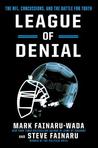 League of Denial: The NFL, Concussions, and the Battle for Truth by Mark Fainaru-Wada
My rating: 5 of 5 stars
Everybody sucks. Everybody in this book just sucks. The NFL sucks. The NFL got stuck in their little damn castle, deny-deny-deny, and even when all their own doctors told them that some of their players had severe brain damage, and they finally loosen up their tight-ass wallets to give some money to the families, even then just deny deny nope no concussion problem in our league deny deny yep we are funding a helmet designed to reduce concussions (which every not-employed-by-the-NFL scientist says is a flawed pipe dream, BTW) but there's no concussion problem so if your son got knocked silly in a high school game that's not our problem deny deny deny. And then the people who study the brains...these assholes. Step all over themselves to prove the NFL wrong, and who cares who's toes you step on. Show Autopsy Photos of the players who's brains showed the damage? Heck yeah. (And I'm not talking the slides of the damaged brain. I'm talking photos of the deceased players, mid-autopsy, and the doctor doesn't even get why people were creeped out) Act like the worst ambulance-chasing nightmares to the families who just had a loved one die in order to make sure they secure the brain before some other research group can? Check and check. Eventually sell out to work for the company you've spent most of your career trying to convince people is harming their employees without admission or remorse? You know they did.
I know, I sound a little bitter and crazed. I get it. Look, I love football. Love it. And I've stepped over many an inconvenient fact in order to protect that love. But there has been a firestorm over the last two decades, building over the horizon, and at some point, I either have to admit that the city is burning down around me, or go down in the ashes. Every week, another report comes out that makes one question his/her fanhood. Another player knocks out his girlfriend or wife. Another player sexually assaults somebody, or beats his kids, and doesn't understand why he can't suit up on Sunday, because he's spent most of his adult life being told that because he can play a game better than 99.9% of us, he's more important. I grew up on this sport. When I was young, Sundays were about going to Grandma's for a big lunch, followed by all of us sitting around a screen to watch whatever game was on. And now...I don't hate football. I don't know that I ever could. But I do not like how it makes me feel. I do not like some of the athletes who play this sport, and how they are sheltered until they finally cross the line where people say, "Well, we can't ignore that, can we?". I hate that the small percentage of those a-holes completely overshadow the mostly decent majority of the league. And I hate that this game has become so fast, and so hard, that it is ruining player's lives, and demolishing livelihoods, and the League will not admit that it is happening despite all evidence, and will not take some of the ungodly amount of money we so easily hand over, in order to provide basic benefits to the retired players who built the empire that they sit on so high to look down on everybody. (And I'm not just talking about concussions....think about how many players need knee replacements, or have sever back or joint issues, especially from the older players who played before their salaries went to a ridiculous stratosphere) Football, right now, is not fun to watch. It's not fun to think about. It's one bad story after another, and over the last few years, I can not watch without wondering why I do pay so much attention.
And I will pay attention. Probably for the rest of my life. That's the part that makes me feel so conflicted. I think about taking the high road, let football go, but then the game's on, and.....yeah. I really do love this game. That's why I was so angry reading this book, because LoD is meticulously written, and takes a long look at everybody involved with the Concussion scandals, and it was thorough and effective. And ultimately, there is nobody that comes out well. None of the problems get solved, and nobody is really clean. And players are still getting obscene amounts of money to possibly (probably) destroy their post-football lives. And come September, I will be sitting in front of the screen, watching again. I will be trying to capture an old feeling. Don't think less of me for it.
View all my reviews
Monday, April 27, 2015
Shaming
I highly recommend the book So You've Been Publicly Shamed, by Jon Ronson. I also just finished Eats, Shoots, and Leaves, by Lynne Truss, but I do not recommend it to anyone unless he or she needs a basic grammar refresher (and doesn't mind keeping the UK/US rules straight while refreshing).
Reading these two books in sequence made for an interesting view of two dynamics. One book shames improper grammar usage, and the other considers the ramifications of over-shaming in the Internet age.
Such matters leave me torn. On one hand, I am absolutely in favor of standards, and I like to shake my cane at anyone who can't write a proper sentence or who minimizes the clarity that grammar provides. I hate to see people hold themselves to low standards, and I do think grammar matters. On the other hand, I really think people get way too uptight about it. It's a balance, and no two people seem to have the same breaking point. Watching people balance that in public becomes its own "failbook" live feed.
My preference w/r/t grammar is to avoid shortcuts and maintain complete sentences whether in e-mail, text, or formal document. Like any good habit, strength comes from regularity. But, I really don't like to see people riding in high-horse competitions, either.
The Internet/text age is here, and it has ramifications. The world won't end as a result, but those who know how to communicate more clearly will hold an advantage. I prefer to strive for that distinction than to herd cats into my way of thinking, but to each her own.
Truss' book left me feeling a little lectured, and made me think of all the times when people went way overboard on innocent mistakes. Typos vs. ignorance isn't always clear. It comes with the territory. Ronson, on the other hand, holds a mirror to us all. He takes the shaming out of "their" hands and places blame into the hands of us all.
I really enjoyed Ronson's exploration of humanity. As usual, his book was entertaining and enlightening. I have come to expect that from Mr. Ronson, and he did not disappoint. After finishing the Truss book, on the other hand, I must fight the temptation to search for evidence of her as a regular Internet "shamer."
Of course, my biggest shame is waiting almost four months to write my first 2015 post.
Subscribe to:
Posts (Atom)