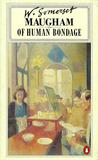
 Of Human Bondage by W. Somerset Maugham
My rating: 4 of 5 stars
4.5/5. One of those things I like to do when I finish a book that I enjoyed, is to find out more about the book, author, and so on. Wikipedia is a boon for this. And has I searched the Wiki, something funny popped off the page. In a couple of different movies/tv shows, a character recommended the book to another, only to have the advice shunned because they, upon hearing the title, believed the book to be pornographic. Which makes me smile for a couple of reasons. I had a similar occurrence when my sibling, seeing the book on my table, immediately said "Yeah, alright Dave, getting duurrrty."
(I reluctantly corrected him, reluctantly because we live in a world where me reading a highly regarded turn-of-the-20th century European coming-of-age story will get a more confused and damaged look than me reading a pornographic S&M novel. I feel lost in life often.)
The other reason is that, although Human Bondage is not a book of sexual bondage, it is focused on how people will tie themselves to other people, in an emotional sense. Human relations are a lot like a spider-web, ropes of feelings splaying out from one person to everybody they interact with, and vice-versa. Some of these are more like strings, barely tied around a finger or toe, barely noticeable even when being tugged viciously. Some are Anchor chains, wrapped around the body and neck and always holding close, always threatening to choke and smother. Philip, the main character, goes through his life collecting these ties, friendship and romantic alike, even when he thinks himself alone and incapable of making connections. He makes friends in Germany and Paris that, at various points will disappear, but the rope is just waiting for one side or another to begin pulling for notice. Philip eventually becomes a doctor, and is lauded not for his medical skill (which is adequate), but his excellent bedside manner, a completely underrated skill for medical professionals. Clearly, Philip has those skills to begin with, but I think his friendships and interactions traveling abroad, before he even decides to be a doctor, hone his people skills to a fine point.
Mildred is a terrible person. Philip, for half the book, is completely obsessed with her, and she knows it, hates it, uses it. Philip stumbles through romance for most of the book, then meets Mildred and consumes himself trying to make her love him. You imagine him wrapping the rope around himself, in effort to attain her regard, and all he does is rob his breath in detriment and barely get a nod from Mildred in consideration. It is a frustrating relationship for us reading it. One gives love to someone addictive and destructive, and no matter how obvious it is to the anybody else , they never seem to see the horrible aspects, or at least do not change their behavior accordingly. And that's how Philip goes through his dalliance with Mildred; he knows that it is terrible, and she doesn't feel the way about him that he feels of her, but the strength of feelings continually rationalize how he feels, and what he expects, to the point where Philip, in a few desperate moments, tells himself that he would rather live with her knowing she hates him then live without her. Finally, towards the end of the book, Philip unties himself, and, in my favorite part of the book, when he runs into her street-walking, he asks her (and her toddler, who is not Philip's) to live with him in order to help her, even through the realization that he does not love her anymore. This is my favorite part of the book, my fist-pumping moment of redemption. Was it stupid to let her back in his life? Yes...but it's a touching, noble stupidity, and it proves and redeems Philips's life up to that point. And of course it does not end well, but...c'mon...not the point. The point is that Philip shows that he is not beholden to Mildred, and he is ultimately a good person. And, in the end, everything works out for him, not just from a Karma perspective, but through his work and skill too. And all the lessons and ideas that the Human Bondage have taught him have shaped him to be the Philip at the end of the book, the person that we root for growing up, that we flinched at every bad move, that we beamed at every lesson learned positively. The ropes you once had may not be there anymore, but the scars and marks left behind will affect you, good or bad.
View all my reviews

No comments:
Post a Comment